(And no, water-cooled filament is not "wet filament")
Drying PETG is still recommended if you want the best print quality, especially with high-flow PETG grades, but modern PETG is less moisture-sensitive than older formulations and usually arrives much drier thanks to better resin chemistry, manufacturing drying, conditioning, and sealed packaging.
If you've been printing for more than a few years, you probably have a mental file labeled "PETG: dry it or suffer." Stringing, hazy walls, popping sounds at the nozzle, brittle layer bonds — for a long time, that was the PETG experience unless you babysat every spool with a dryer, no matter whether you were using basic PLA or more advanced options from a broad 3D printing filament catalog.
That reputation was earned. But it's also increasingly out of date. For hobbyists, professionals, engineers, and industrial users printing with PETG, the important shift is that PETG in 2026 is not the PETG of 2018, and the difference comes down to chemistry, process control, and packaging — three things that have quietly improved across the industry, and that we obsess over at Polymaker in both our retail range and US wholesale 3D printing materials program.
So if you're trying to decide when drying PETG actually helps, what moisture problems still look like in real prints, why water-cooled filament is not the same as wet filament, and how newer and high-flow PETG grades should be handled, this section will give you the current picture. Understanding that difference helps you avoid defects, store filament more sensibly, and get better, more consistent results from today's materials.
Two things get conflated in every "wet filament" thread:
A filament can be moderately hygroscopic and still arrive bone-dry if it was dried and sealed properly. Conversely, a "low-moisture" material stored open in a humid workshop will eventually print like soup. Modern PETG has improved on both fronts, and broader access to these materials through Polymaker’s EU storefront and shipping options makes it easier for more users to benefit from these improvements.
PETG is a type of copolyester made by modifying PET to prevent crystallization and keep it easy to print. However, "PETG" covers a range of materials, and today's resins are quite different from those used years ago.
Fewer moisture-attracting ends. Water sticks to certain chemical groups at the ends of polyester chains. Older or poorly dried resins have more broken chains and more of these groups, so they absorb more water. Modern resins have better control over this, meaning less moisture absorption.
Improved resin formulas. At Polymaker we have fine-tuned the resin mix to reduce how much moisture the material takes in and how fast, without losing clarity or strength.
Cleaner resin. Cheaper resins contain leftovers from production that speed up damage from moisture. Resins with fewer impurities resist moisture damage more effectively, reflecting Polymaker's commitment to producing high-quality materials that meet rigorous standards for performance and reliability.
Better overall durability. PETG made from properly dried resin stays stronger and less prone to moisture damage over time. Many old stories about PETG soaking up water come from spools that were damaged before they were even made.

Chemistry aside, the manufacturing process has professionalized enormously:
That's why a fresh spool from a serious manufacturer prints glassy and clear straight out of the bag, while PETG can absorb enough moisture to affect quality within 2–12 hours at about 55% relative humidity, depending on conditions. So an opened filament spool left out may need drying promptly. The material didn't change; the storage did. Silica becomes less effective below 10% RH, so its main role is to maintain a dry sealed container after drying: use silica packs when you store filament to prevent moisture absorption, since they limit moisture absorption by absorbing moisture inside the package rather than driving humidity lower.
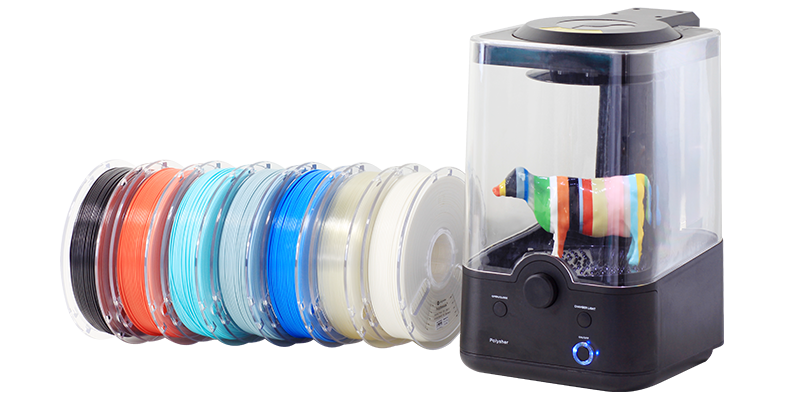
Every time filament moisture comes up online, someone points out that factories cool filament in water, followed by the conclusion that water-cooled filament must therefore be wet. This one deserves a proper burial, especially when you consider how products like the PolyDryer™ modular 3D filament dryer are specifically designed to control moisture long after manufacturing.
Yes, virtually all filament is water-cooled. After extrusion, the molten strand must be cooled rapidly and uniformly, or you can't hold tight diameter and ovality tolerances. A water bath (or trough) is the standard way to do that across the industry, including for premium filament. Air-chilled roller systems exist, but water remains the norm because it works extremely well.
No, that does not make the filament wet. Here's why:
So when you see "all factories use water cooling" cited as proof that all filament ships wet, the premise is true but the conclusion doesn't follow. The spools that arrive wet were let down by what happened after the water bath: skipped drying, slow packaging lines in humid air, or damaged packaging in transfer. That is where sensible precautions matter if you want to dry and seal material effectively, because the real risk is lower print quality rather than high quality prints, plus weaker, more brittle parts if poor handling is allowed to lead to bad downstream moisture control. Cooling method is the one step in the chain that's essentially irrelevant.
If you've tried one of the new high-flow PETG grades built for 300–600 mm/s CoreXY machines — including our own high-speed formulation — you may have noticed something that seems to contradict everything above: these materials are more moisture-sensitive than standard PETG, not less. They absorb faster, and they punish wet printing harder.
This is a deliberate chemistry trade-off, and it follows directly from the same physics we've been discussing.
High flow means shorter chains. The primary way to make PETG flow cleanly at extreme volumetric rates is to lower its melt viscosity, and the main lever for that is molecular weight. Shorter polymer chains mean more chain ends per gram of material — and chain ends are exactly the hydrophilic sites where water binds. High-flow grades intentionally trade back some of the end-group advantage that modern standard grades gained, in exchange for speed.
Wet HF strings more. High-flow grades run hotter and push material through the nozzle faster. The same moisture content that produces mild haze in standard PETG flashes to steam more violently at HF conditions — so part of the reputation is genuinely faster uptake, and part is that identical moisture levels produce more visible defects.
The practical takeaway: high-flow PETG is the one category where the old-school drying discipline still fully applies, and drying filament should follow the filament type: PETG can be manageable with routine prep, while HF PETG needs tighter humidity control. Keeping filament dry is also essential, so print from a drybox in humid conditions and reseal the roll after use. That's the price of admission for tripling your print speed. Better for you to know this before your print fails mid-print.
Should you still own a filament dryer? Yes. It's the single best insurance policy in 3D printing, and decent models are available for around $60, with real advantages because they simplify the drying process; promising newer units can replace improvised setups, though the key point is controlled heat rather than whether you preheat first. Additionally, for PETG, aim for 4–6 hours at 60–65°C. A dedicated system like the PolyDryer™ filament drying and storage solution simplifies this process, while a food dehydrator can work too, with adjustable temperatures up to 170°F, and an oven or convection oven at about 65°C can be effective but risks overheating and softening or even melting the spool.
Modern resin grades absorb less and degrade slower; modern high quality production lines dry, monitor, and seal to standards that simply didn't exist in the hobby's early days, and a wide range of these Polymaker 3D printing filaments is now readily available to hobbyists and professionals alike.
Print a transparent vase in fresh PETG and see for yourself. Clarity doesn't lie.
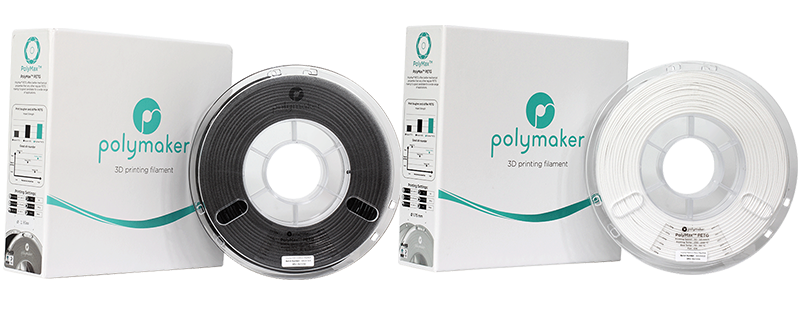
All Polymaker filaments are dried and sealed with desiccant in barrier packaging before shipping.























Please fill in the form below or if you have other questions are not included in the form, please contact us through [email protected]. We will get back to you soon.
Please fill in the form below or if you have other questions are not included in the form, please contact us through [email protected]. We will get back to you soon.